




Experts Call for Media Resilience, Unity Amid Growing Threats to Civic Freedoms | ClipTV Online
 Abraham AdaranijoAugust 15, 20263 Mins read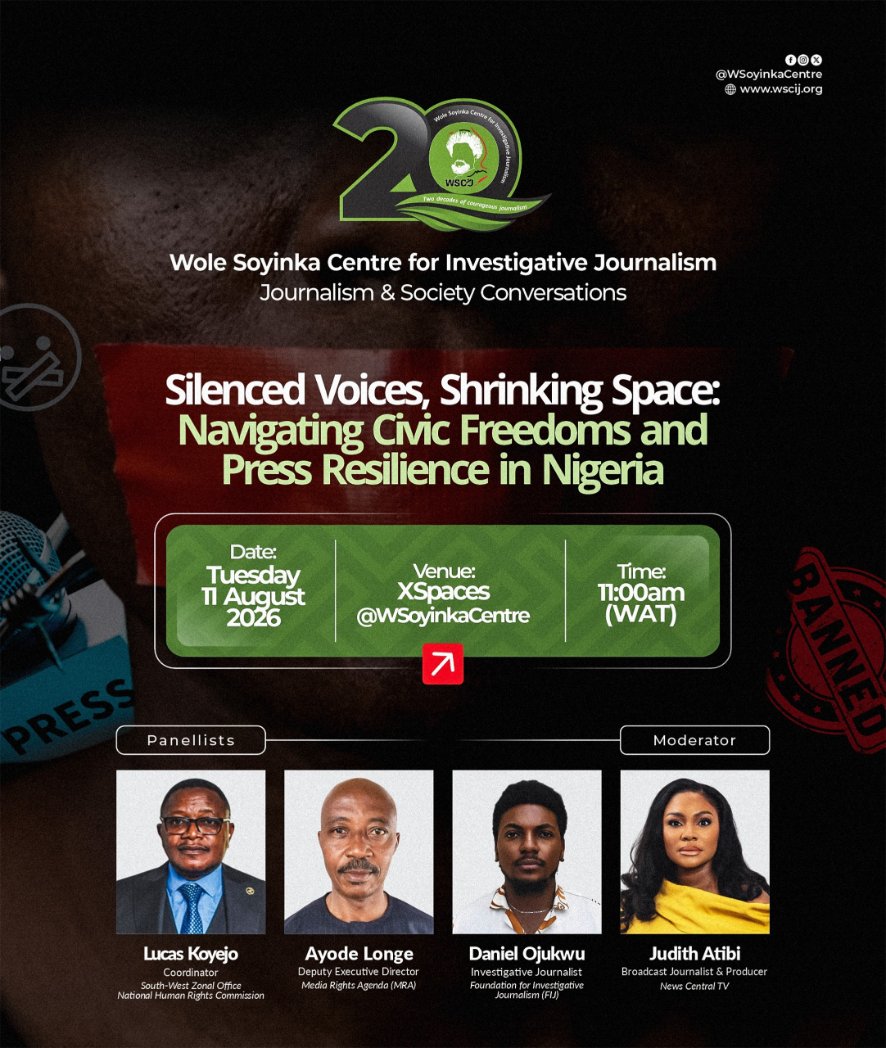
As the Civic Space continues to be under pressure, the Wole Soyinka Centre for Investigative Journalism (WSCIJ) has convened a media conversation on the topic. The discussion probes the shrinking civic space, press resilience, and the growing concerns surrounding freedom of expression in Nigeria.
The discussion, titled “Silenced Voices, Shrinking Space: Navigating Civic Freedoms and Press Resilience in Nigeria,” brought together journalists, civil society actors, and other stakeholders. The group reflects on the challenges confronting the media and civic freedoms in the country.
The Program Officer, Mariam Alo, highlighted the reason for convening the gathering. Mariam noted that the 2025 civic space report showed a trajectory of concerns and has necessitated a call for attention. She added that the report records 245 cases across different media platforms.
Mariam explained that journalists have been maltreated in different ways; however, the 2025 Civic Space Status report indicates that 55.3% of these cases were against regular citizens. She further noted that, with elections around the corner, it is crucial to have round pegs in round holes, hence the germane discussion.
At the opening of the session, Judith Atibi described the conversation as timely and prompt. She particularly noted that it is against the backdrop of the continued shrinking of civic and media spaces in Nigeria.
Atibi also noted that the discussion was designed to examine the experiences of those who have faced pressures related to journalism and civic engagement. Adding that journalists and other actors have remained resilient in the face of such challenges.
According to Atibi, the issue extends beyond journalists’ experiences, as the broader question of civic freedom concerns citizens’ ability to express themselves, participate in public discourse, and contribute to democratic processes.
She further explained that the panelists were chosen for their experience with press freedom, civic rights, and the challenges of continuing to tell stories and speak honestly in difficult circumstances.
The session comes amid continuing concerns about the operating environment for journalists and civic actors in Nigeria.
Furthermore, it focuses on issues related to freedom of expression, access to information, public accountability, and the protection of civic participation, which remain important subjects in national discourse.
For WSCIJ, the focus on “silenced voices” and a “shrinking space” reflects the importance of documenting the experiences of journalists and citizens while encouraging greater resilience within the media and wider civic community.
Responding to practical measures media organizations should adopt to reduce the “shrinking space” and sustain true safety for investigative journalists in the sector, Daniel Ojukwu, an investigative journalist with the Foundation for Investigative Journalism (FIJ), underscored the need for internal fact-checking before publication. He stated that organizations should ensure adequate scrutiny, “not being sensational or jumping the gun,” he said.
He added, “We wrestle not against flesh and blood but principalities and powers.” Ojukwu noted that institutions and individuals whom journalists encountered during the investigation are quite powerful and resourceful. Therefore, journalists need legal aid, support from other journalists, and media houses; otherwise, the opposition can cripple them and frustrate their efforts. He emphasized the importance of funding or sustainability, adding that traveling to places for information and interviews can sometimes be frustrating and challenging, based on personal experience.
The experienced investigative journalist further notes that another practical measure to adopt is training and retraining journalists. He concluded that the training should be tailored to emphasize understanding of their civil rights and to avoid intimidation.
Another crucial layer was added to the event by Mr. Ayode Longe, Deputy Executive Director, Media Rights Agenda. He highlighted a case in which a presiding judge of the FCT High Court, Abuja, Justice Halilu Yusuf, awarded N100M against the Socio-Economic Rights and Accountability Project (SERAP). The judgment given on May 5, 2026, involved SERAP against Sarah John and Gabriel Ogundele of the Department of State Services (DSS) operatives.
Longe added that while some Civil Society Organizations (CSOs) encouraged SERAP to file an appeal, others recommended paying the penalty and closing the case, underscoring the divide among media outlets. He stated that to adequately fight the repression by state and non-state actors, disunity among media outfits has to be a thing of the past.
Equally, he noted that while the 2025 WSCIJ report is alarming, it is important to recognize that individuals should be able to express themselves without harassment or abuse. “Freedom of expression is the foundation upon which every other human right is built,” he highlighted.
Longe further stated that the number of nonviolent attacks is now more than violent attacks, according to the WSCIJ report. State actors used legal proceedings, detentions, and other administrative measures to sanction journalists and shrink the civic space. Adding that according to the report, “state actors constitute 89.4% of the perpetrators,” he raised eyebrows. “The constitution says the responsibility of government is the welfare, safety, and security of its citizens,” he added. He then raised the concern that those who are supposed to protect the citizens are the ones repressing the journalists and other members of the public. Longe concluded that there is a need for freedom of expression and peaceful gathering; otherwise, other rights will be easily abused.
The media experts and veterans continue to use investigative journalism, media engagement, and civic-space initiatives to promote accountability, human rights, and democratic participation in Nigeria. The discussion provided an opportunity for participants to examine the pressures confronting journalists and civic actors, share experiences, and explore practical approaches to strengthening press resilience and protecting civic freedoms.
Author






Related Articles
THRIVE: Yetunde Oni Shaping Nigeria’s Next Generation of Leaders | ClipTV Online
Union Bank’s Managing Director and Chief Executive Officer sat with 30 of...

Broken Father, Broken Son: JTAH Sparks Conversation on Men’s Mental Health | ClipTV Online
The need to address the emotional and psychological challenges faced by men...

Count Down: TPS Reiterates Media Importance, Extends Workshop to Students | ClipTV Online
As the Press Society (TPS) media sensitization event approaches, the coalition of...

NCC Targets Poor Network Zones, Introduces LGA-Based Tracking | ClipTV Online
As Telcos faces renewed regulatory The Nigerian Communications Commission (NCC) has unveiled...
Leave a comment